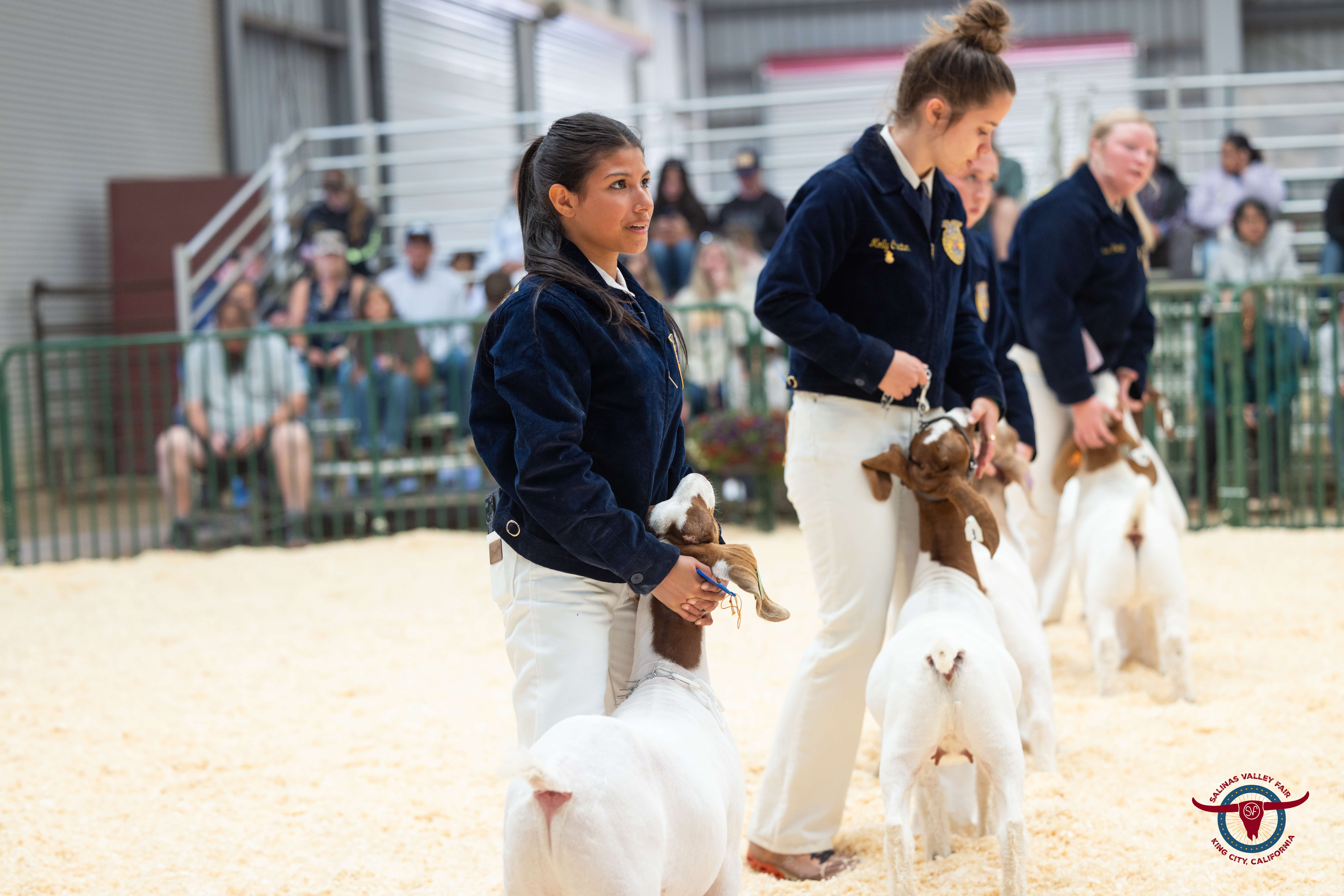
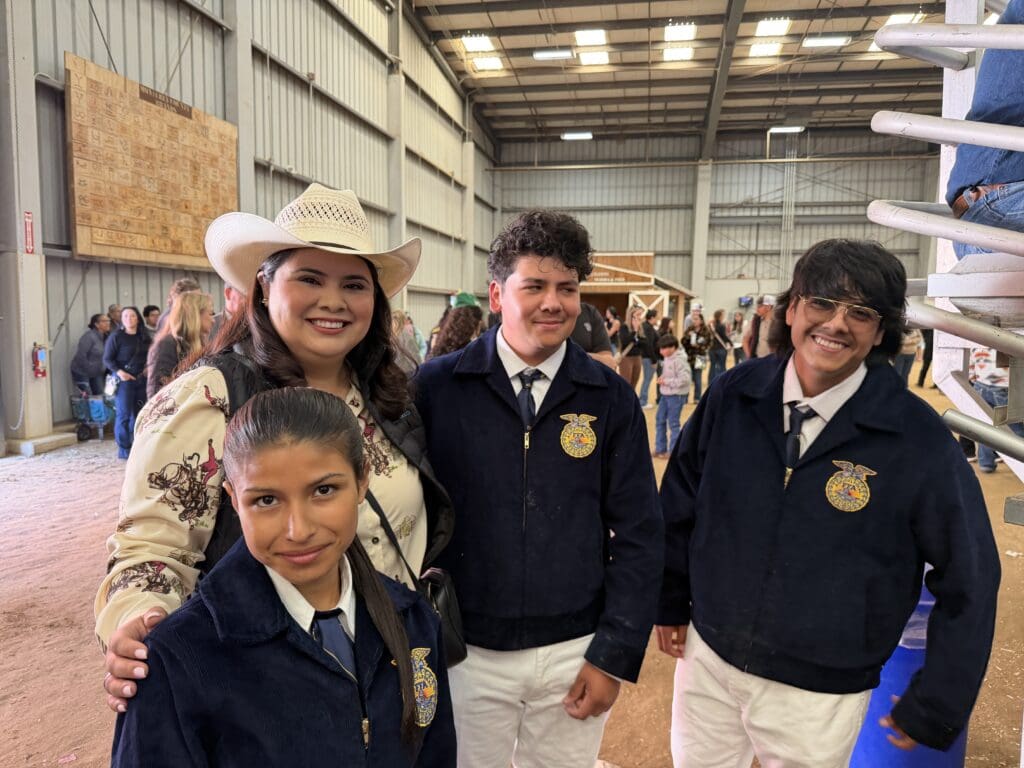
It is a sunny afternoon in May, and three goats are being blow-dried patiently near their pen at Hope, Horses & Kids’ stables, Rancho Cielo’s onsite nonprofit partner. Their fur lifts in the warm air, one of the last details of a long grooming process before their big debut. In a few hours they will be taken to King City for the Future Farmers of America (FFA) Goat Showmanship competition at the Salinas Valley Fair. The bathing, the brushing, the tagging of ears—all of it arduous, all of it necessary, all of it leading to three Rancho Cielo Ag Tech students, Jasmin, Juan and Gonzalo, walking into a show ring for the first time.
They are not alone. They have Eddie Chambers.
Chambers is 17, a 2026 graduate of Rancho Cielo’s Ag Tech Program, and he’s been around farm animals nearly as long as he can remember. He started showing at state fair competitions through 4-H at the age of eight. By the time Jasmin, Juan and Gonzalo needed someone to walk them through the unglamorous mechanics of readying a goat for competition, Chambers was the obvious choice. He knew what they did not yet know: Showmanship is built in the small, repetitive hours before anyone is judging.
This year, at the CA State FFA Leadership Conference in Ontario, California, Chambers received something larger than a ribbon. He accepted Rancho Cielo’s official National Future Farmers of America charter membership, powered by the nonprofit’s educational partner John Muir Charter Schools. Chambers also earned his CA State FFA Degree, the highest honor the CA FFA Association gives, reached by only about 3% of its more than 100,000 members. The number matters here, the way numbers always matter when they are meant to communicate scarcity, meant to say: This was hard, and few do it. Chambers can now pursue the American FFA Degree, an honor that goes to just 1% of FFA members nationwide.
Other Ag Tech students, meanwhile, are working quietly toward something less ceremonial but no less real: their Youth for the Quality Care of Animals (YQCA) certification, a nationally recognized animal care credential for participants ages eight to 21. All Ag Tech students will work toward it now, whether or not they plan to show animals.
The goats, in the end, placed seventh overall in showmanship at the Salinas Valley Fair. The following day, Jasmin, Juan and Gonzalo sold their goats in the Junior Livestock Auction, and the sale went well, with every dollar circling back to the students’ own education and hands-on learning. The students who chose not to participate in the animal side of the program did not come away empty-handed either. They had 21 Still Exhibit entries, boasting floriculture masterpieces, from a succulent table and chairs set to wine barrel gardens, garnering two Best in Shows, more than 10 first-place ribbons and four second-place ribbons. It is the kind of tally you read twice, because it suggests a program working at a different speed than it was just one year ago.
That speed has a name, more or less, and the name is Matt Marshall.
Marshall took leadership over Rancho Cielo’s Ag Tech program last year, and since then the energy around it has been active, beginning with the development of Rancho Cielo’s Future Farmers of America chapter. Marshall came to this work via a degree in Agricultural Science from Cal Poly, concentrated in Animal Science, followed by a Master’s in Agricultural Education. He also teaches agriculture courses at Hartnell College, which matters more than it might first appear.
“My goal is for [the Ag Tech program at Rancho Cielo] to have a strong identity,” Marshall explains. He sees potential in developing the program with three distinct pieces: ag business, animal science and plant science, with coursework and hands-on vocational experience in each area.
“It makes sense, because that’s where the student interest is, but also those are the three specific degree transfer programs at Hartnell,” Marshall says. “If we create that strong identity, we can create stronger partnerships and dual enrollments [in those areas] with Hartnell.”
Already, students are finding their way into stronger threads of the FFA curriculum, working with Rancho Cielo Garden Manager/Master Gardener Julie Lorenzen and California Climate Action Corps (CCAC) Fellows on various projects, including a native hedgerow, which is groundcover planted to mimic a natural ecosystem.
“It’ll be exciting for new students to see that grow and evolve as we’re talking and building some infrastructure, looking for support to build a farm, build some facilities, buy some equipment to make that identity even stronger in ag business, plant science and animal science,” Marshall says.
There is a detail worth pausing on, because it explains something about how FFA functions in this state: In California, the moment a student enrolls in an ag program like Rancho Cielo’s, that student becomes an FFA member. Automatically. No separate application, no second commitment.
“That’s the beauty of FFA; you know it offers a variety of opportunities, and kids can pick and choose which ones they want to be involved in, experiences that they like,” Marshall explains. “Some students want to do more plant things; some want to do animal things.”
As advisor, Marshall watches for the students who show initiative, who are managing their academics well enough to take on something more.
“We want to put students in position to be successful and have that ability to manage their academics and another commitment, like [caring for] an animal,” he says.
And then there is land. A five-acre plot, to be specific, between Rancho Cielo’s vocational center and Hope, Horses & Kids has been marked out as a potential development site, and Marshall talks about it the way people talk about things they have already built in their minds, waiting only for the world to catch up.
“I guess long term, my goal is to build,” Marshall says. “I’m calling it an ‘Agricenter,’ a set of facilities that allows those three core curriculum areas of ag business, plant science and animal science to come to life out here. We could have an operational farm and a student store that students can manage, farm-produced goods that the community can come out and buy.”
The Hartnell connection runs both directions. Hartnell wants to grow its animal science program but lacks a functional farm of its own; if Rancho Cielo builds one, Hartnell students could come out for classes and labs Marshall would teach himself, and Rancho Cielo students could leave with college credit already in hand. Two institutions, one piece of ground, each growing because of the other.
As for Chambers, the work does not stop simply because the fair is over. As he works toward his National FFA Degree, he recently received a scholarship from the Monterey County Heritage Foundation, one more line in a record that started with an eight-year-old at a 4-H competition and has not slowed down since. Chambers recently acquired three pigs that are enjoying new digs at Hope, Horses & Kids’ facilities. He’ll be showing at least two of them at the San Benito and Monterey County Fairs in late summer.
There is also, Marshall mentions almost in passing, a new internship taking shape in partnership with Hartnell and National Oceanic and Atmospheric Administration (NOAA) that will teach Ag Tech students landscape construction through the lens of environmental conservation. It is a small thing to mention last, and, perhaps, the thing that says the most about where this program is headed: not just toward ribbons and degrees, but toward land itself, and what a person learns by being responsible for it.